
Parashat Vaetchanan: Everything about Judaism is the Sh'ma
Jews have a prayer for everything. Bread, wine, candles. The hurting, the dead. Hell, there's even a prayer for after sex—yes, this is real[1]. If you can think of it, there's a prayer for it. And if there isn't a prayer for it, there's a meal for it. What prayer can't heal, a good chicken soup can.
But if there's one prayer that serves as Judaism's greatest hit—our equivalent of a chicken soup declaration that covers everything—it's the Sh'ma. Front and center in this week's Torah portion, Parashat Vaetchanan, the Sh'ma gets repeated constantly and emphatically throughout our services. We're supposed to recite it daily, in times of stress, and in relief. Sh'ma Yisrael, Adonai Eloheinu, Adonai Echad. Hear, O Israel, Adonai is our God, Adonai is One.
But why this prayer, and why so often? The easy answer is that we're commanded to—but that's the boring answer and I wouldn't be writing a 1000+ word essay on it if that's all there was to it.
Repetition dominates this Torah portion. In Moshe's final, emotional plea to the Israelites, he reminds them what it's like to turn away from God and retells the Ten Commandments and other laws. It's continuation from last week—Moshe is nearing the end of his life, knowingly barred from entering the Promised Land, and recounting the events that brought him and his people to this threshold.
But repetition here isn't redundancy. It's knowledge transmission. Moshe speaks to those who stood with him at Mount Sinai, the emerging generation who weren't there, and—most importantly—us, the readers who must learn all of this from our biblical ancestors. He's building a legacy of people who don't just know the law but internalize it. The Sh'ma shouldn't merely be read; it should be engraved into daily life.
Like my sixth-grade math teacher trying to get me to understand fractions said, "Write this on the inside of your eyelids if you're not getting it." (She was a bitch, but she had a point.)
The Sh'ma carries an affirmation core to Jewish identity that stretches across time and space. "Hear, O Israel" calls for community—not individual attention. "Adonai is our God, Adonai is One" declares radical monotheism with no room for division or compromise.
I've been careful not to drag other religions that preach monotheism while practicing something decidedly more complicated, but here's the setup: Judaism emphasizes steadfast community over individual relationships with God and refuses to budge on this one-God thing. No three-in-one. No "sons of." Adonai is just one.
But the Sh'ma transcends theological declaration—it's a lifestyle blueprint. Following the Sh'ma are the V'ahavta commandments: "Love Adonai your God with all your heart, soul, and might... Impress them upon your children. Recite them at home, when you are away, when you lie down, and when you get up."
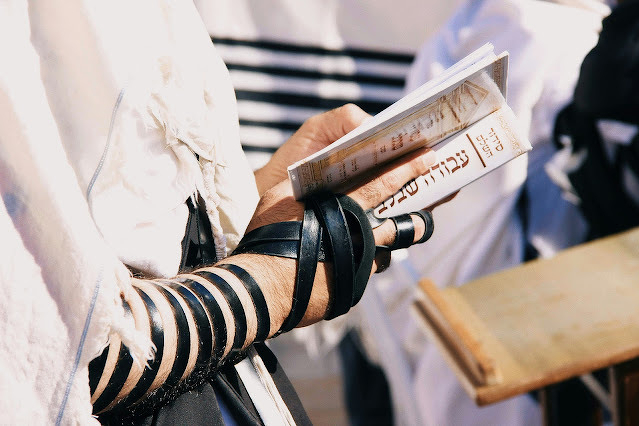
Then comes the practical stuff: "Bind them as a sign on your hand and let them serve as a symbol on your forehead"—hello, t'fillin—"inscribe them on the doorposts of your house and on your gates"—enter the mezuzah. Also note: in Jewish folklore, golems were inscribed with the Sh'ma to give them life and destroyed when the Sh'ma was erased.
This isn't abstract. The Sh'ma creates embodied, practiced, physicalized faith—a daily rhythm of mindfulness with visible symbols. Mezuzot and t'fillin serve as spiritual sticky notes of this affirmation.
There's urgency in Moshe's plea, not just because his time is ending, but because he wants the covenant with God to endure. The only path to permanence is repetition. From Moshe until now, the Sh'ma has been the link—its repetition ensures continuity.
Saying it daily, before bed, in crisis, and at death shapes Jewish identity not just through belief, but through memory, ritual, and language. Moshe will die. We will die. But the affirmation and connection persist.
With all the repetition and rituals in Jewish life, the Sh'ma remains the most straightforward—a declaration of loyalty, a spiritual instruction manual for living as a Jew. Just as Moshe repeated these words for the next generation of Israelites, we inherit the task of not just remembering but living and transmitting them.
Whether we wrap t'fillin or affix mezuzot to our doorways, we continue listening to Moshe, even today. Not bad for a prayer that covers everything.
[1] Rotem, Rabbi Efrat. “A Blessing after Making Love.” Mishkan Ga’avah Where Pride Dwells, edited by Rabbi Denise L. Eger, New York, NY, CCAR Press, 2020, p. 40.