
Confessions of a Reformed Pilates Skeptic
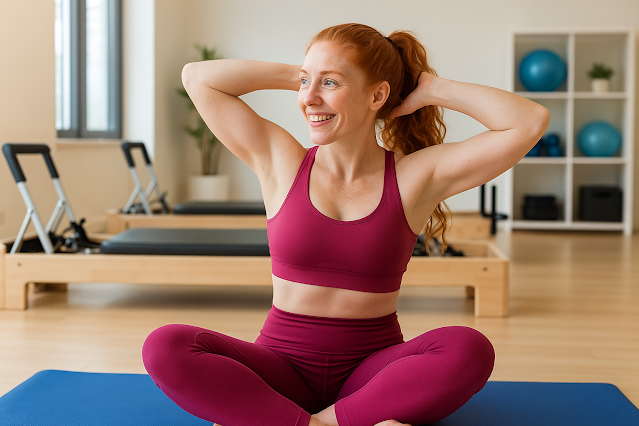
Five years ago, if you'd told me I'd become someone who voluntarily contorts themselves on dicey-looking contraptions while an instructor cheerfully suggests I "breathe into my pelvic floor," I'd have gone to therapy sooner. Yet here we are, and like all good conversion pieces, mine began with the pandemic.
(Note: the picture above is NOT me. It's AI-generated -- sorry. But I did so as an experiment to see how well I could prompt it into creating an image of me doing Pilates. Results: kinda weird!)
March 2020 arrived with its familiar apocalyptic fanfare, and I made the same calculation as millions of other suddenly homebound humans: if I'm going to be trapped indoors indefinitely, I might as well do something productive before my inevitable descent into madness. So I bought a rowing machine and began what I now cringe to call my "Fitness Journey"—a phrase that makes me sound like someone whose personality revolves around kale smoothies and unsolicited rep counts. For the record, I do write books. It's just that nobody asks about those at parties.
Within months, I was cobbling together routines from YouTube and Apple Fitness Plus, including something called Pilates—a word I'd only heard whispered mockingly about suburban moms in designer athleisure queuing for classes like they were waiting for limited-edition handbags. But I needed core strength, and mine was demonstrably theoretical at the time.
The results were undeniable: forty pounds lost in nine months, though I credit a combination of movement, medication changes, and the general apocalyptic stress of existing in 2020. Still, when a Pilates studio featuring what can only be described as torture devices disguised as exercise equipment opened in town, I was intrigued. These "Reformers" look like something from an S&M dungeon, but I'd learned that Pilates was originally created and practiced on an apparatus—Joseph Pilates developed his method for bedridden WWI soldiers using springs and dowel rods, because apparently nothing says "rehabilitation" like contraptions that resemble medieval siege engines. Nobody expects the Spanish Inquisition, indeed.
One class convinced me. Where had this been all my life? I signed up for a membership faster than you can say "three-month commitment."
Now, before you conjure images of that SNL sketch, let me dispel some persistent myths about this particular form of sanctioned masochism:
Myth 1: Pilates is either impossibly hard or laughably easy.
Neither is true. Pilates is precisely what your body needs it to be—a methodology that combines stretching with resistance training, adaptable to whatever physical disaster you're currently managing. You won't find screaming instructors hurling tires or anyone puking from burpees, but you also won't find gentle stretches accompanied by whale sounds. Your muscles will work, your core will engage, and you'll discover stabilizer muscles you forgot existed. It's challenging without being punitive, which is refreshing in a culture that treats exercise like penance.
Myth 2: Pilates is a "women's workout."
This one's particularly galling given that Pilates literally invented his method for injured male soldiers. The current female-heavy demographic is pure marketing—the fitness industry has simply figured out that women are easier targets for body-improvement messaging. We're more susceptible to "You're not enough, but this expensive thing might fix you" advertising, whether it's Pilates, yoga, or whatever boutique torture method is trending. Meanwhile, capitalism cheerfully profits from our collective insecurities while selling us scubas with matching leggings.
Myth 3: You must be conventionally attractive/thin/flexible to participate.
One class will cure you of this delusion. My studio is populated by every conceivable body type, fitness level, and age bracket. There's an older gentleman who keeps up with the class, soccer moms in oversized t-shirts, former dancers, and people who clearly just wandered in from their couch. Everyone gets corrections, modifications, and the occasional gentle reminder that showing off your splits during leg circles isn't actually the point. The beauty of a room full of people concentrating on their own movement is that no one has time to judge yours.
Myth 4: The equipment looks like sex/torture devices.
Okay, this one's completely accurate. While the Reformers are unsettling, the Cadillacs are worse. You can even hang from them. I can only make so many excuses, but then there's the fuzzy leg cuffs (which I've used before). No way to talk out of that. And don't knock it until you try it.
The real revelation isn't the physical transformation—though my core could now probably survive a minor earthquake. It's the unexpected joy of movement that doesn't feel like punishment, the strange satisfaction of micro-adjustments that create macro-changes, and the discovery that I genuinely enjoy something I once mocked.
Which brings me to my latest plot twist: I'm training to become an instructor. Look: when life hands you a global pandemic and some spare time, you don't just find a new hobby—you prepare to evangelize about it to other skeptics who think they're too up-their-own-ass to try.