
2025
Parashat Vayetzei: When Dreams Do the Heavy Lifting

Parashat Vayetzei gives us the origin story of the twelve tribes, though it's less Marvel Cinematic Universe and more "everyone makes questionable decisions based on dreams." Six tribes come from one woman who wasn't the first choice. Another comes from the favorite wife. The rest come from handmaidens who definitely didn't sign up for this particular job description. It's a parashat where dreams drive the plot forward with the narrative efficiency of a screenwriter who's running out of pages.
Let's start with Leah, matriarch of eldest daughters everywhere.
Jacob sees Rachel first—shapely and beautiful, as the text helpfully notes. Leah gets described as having "weak" or "tired" eyes, which is biblical for "she has a great personality." Jacob falls so hard for Rachel that seven years of labor feels like a long weekend. Then comes the morning-after plot twist: surprise, you married the wrong sister.
The real gut punch isn't the deception; it's what happens next. Jacob immediately negotiates another seven years to marry Rachel properly, just a week later. Imagine being Leah in that moment. Not chosen, not wanted, just there. A consolation prize with tired eyes.
As the eldest daughter who carries Leah as my Hebrew name, I feel this in my bones. She didn't choose this arrangement—her father decided her future while she got to live with the consequences. Yet she keeps hoping. After each son—Reuben, Simeon, Levi, Judah, later Issachar and Zebulun—she prays that maybe this time Jacob will see her. Maybe this time she'll be enough.
The text never tells us she gets what she wants.
But here's the thing about being second choice: sometimes you end up being the foundation. Leah's sons (plus those of her maidservant Zilpah) make up eight of the twelve tribes. Judah alone will produce King David, flawed as he is. While Leah dreams of Jacob's love, she becomes something else entirely—not an afterthought but a Matriarch, remembered not for being loved but for building a people.
Dreams in this parashat aren't just wishful thinking. They're narrative workhorses.
If you've seen Jacob's Ladder—and if you haven't, spoiler alert for a thirty-five-year-old movie—you know Tim Robbins plays a Vietnam vet haunted by visions of his dead son and constant suggestions that he's already deceased. Which, surprise, he is. The film's climax features a staircase into bright light, with pre-Home Alone Macaulay Culkin leading him up.
It's a darker take on our Jacob's desert vision. After falling asleep on a rock (the biblical equivalent of a highway rest stop), Jacob dreams of a cosmic escalator with divine messengers commuting between heaven and earth. It's either profound spiritual revelation or what happens when you're dehydrated in the desert. Ask anyone who's been to Burning Man.
This is where God renews the covenant, promising Jacob this land and descendants who will spread across the earth. "Wherever you go, I will lead you back to this promised land." Jacob wakes up, declares the place Beth-el (House of God), and heads off to Haran to marry Rachel and Leah and father a nation.
Later, when Jacob flees Laban with his wives, children, and considerable wealth, Laban has his own dream—God warning him not to harm Jacob. It's less mystical vision, more divine restraining order. Dreams as covenant, dreams as boundaries.
But which dream transforms the most? Jacob's celestial stairway that reaffirms divine promise? Laban's warning that establishes protective limits? Or Leah's unspoken longing that builds a legacy?
The answer is all of them, and none of them, and that's the point. Jacob's dream reminds us of our covenant. Laban's dream protects that covenant with boundaries. And Leah's dream—her stubborn hope in the face of rejection—creates the very people who will carry that covenant forward.
So may we, like Jacob, remember we're part of something larger. Like Laban, may we respect the boundaries that keep us whole (even when divinely mandated). And like Leah, may we build something lasting, even when—especially when—we feel unseen. Sometimes being second choice means you get to be the foundation. Sometimes tired eyes see farther than beautiful ones.
When Words Stop Working

In linguistics, words evolve along predictable paths. There's amelioration, where words improve over time—"bad" now means both terrible and smoking hot, depending on your inflection. Then there's pejoration, the far more common descent into darkness, where innocent bundles of sticks and clinical terms become slurs I won't type here.
But there's a third evolution that's less academic and more vibes-based: semantic bleaching. Words lose their punch entirely. "Awesome" once meant genuinely awe-inspiring; now it's what you say when someone brings donuts to the office.
Take "unhoused," a term that's been bothering me lately. Not because housing isn't a crisis—five states have over 10,000 people sleeping outside, rents have skyrocketed since 2013, and somehow we're building apartments no one can afford. The problem is that "unhoused" makes it sound like people just misplaced their houses, like they left them in their other purse.
Let's be real. This country doesn't have an "unhoused population" problem. It has a homelessness crisis caused by addiction, mental illness, domestic violence, medical bankruptcy, unemployment, and a housing market that requires selling organs to make rent. These people weren't "unhoused"—they were systematically excluded from housing. The passive voice lets the system off the hook.
Which brings me to another phrase that's been bleached of all meaning: body shaming.
Originally, this term had teeth. It called out the systematic discrimination against larger bodies—the limited clothing options, the medical bias, the employment discrimination. It named something real and harmful.
But then something Wicked happened. Or rather, the Wicked discourse happened, where suddenly commenting on Ariana Grande and Cynthia Erivo's appearances became "body shaming." The internet exploded with concern trolling disguised as health worry: Are they on Ozempic? Do they have eating disorders? Are they crying because they're hungry?
Here's the thing: there's no systemic shame in being thin. Thin bodies—preferably white, European ones—have been the beauty standard since forever. BBLs and curves might trend, but slenderness always returns as the default. You can't "shame" someone for meeting the beauty standard any more than you can shame someone for being rich. The system that creates these standards? That's shameful. The women trying to promote their movie while existing in bodies? Not so much.
I've been there. A few years ago, I lost thirty pounds through exercise and felt fantastic—cheekbones emerged, obliques appeared, pants needed belts. Then I moved cross-country and stress withered away another ten pounds. The difference was stark: suddenly I looked like a Victorian consumptive, all clavicles and countable ribs. But nobody shamed me. If anything, people asked for my "secret."
We can't diagnose celebrities through screens. Maybe Grande and Erivo have disordered eating. Maybe they're stressed from endless press tours. Maybe their bodies just respond to pressure this way. But calling speculation about thin bodies "body shaming" dilutes a term that once described actual discrimination. Fatphobia is real—it affects healthcare, employment, basic dignity. That's not the same as your aunt making snippy comments about second helpings.
This is what semantic bleaching does: it takes words with specific, important meanings and stretches them until they snap. "Awesome" for everything positive. "Unhoused" for a systemic failure. "Body shaming" for any observation about any body, regardless of context or power dynamics.
Language evolves—that's inevitable. But when we let important words dissolve into semantic mush, we lose the ability to name real problems. And if we can't name them, we certainly can't fix them. Sometimes a word isn't just a word; it's a tool. And right now, we're letting our tools go dull.
Nobody Wants This, But Everybody Does
The second season of "Nobody Wants This" just dropped on Netflix, which means we're back to watching a hot rabbi chase after a problematic shiksa goddess while the show can't decide if it's Reform, Conservative, or just LA Jewish. Despite its overarching themes of personal growth and leaving baggage behind, it manages to depict Jewish women as walking Yiddish dictionaries with volume control issues. It's a shanda. Skip it.
But I'm not here to talk about the show. I'm here to talk about its star, Kristen Bell, who recently celebrated her wedding anniversary by posting a photo of husband Dax Shepard with this caption: "Happy anniversary to the man who once said, 'I would never kill you. A lot of men have killed their wives at a certain point. Even though I'm heavily incentivized to kill you, I never would.'"
The timing? Chef's kiss. Right before her show's promotional tour. During October. Which happens to be Domestic Violence Awareness Month.
Not a good look, Boris.
For context: Bell is Detroit royalty to me. We grew up miles apart (Oakland vs Wayne County—practically neighbors by Michigan standards). She gave us Veronica Mars, voiced Anna in those Frozen movies that parents pretend to love, and absolutely ate and left no crumbs in The Good Place. But most importantly, she was Mary Lane in Reefer Madness, which automatically grants her lifetime cool points in my book.
Her husband? Also Michigan stock. You know Dax Shepard from his "Armchair Expert" podcast, various forgettable comedies, and as Ashton Kutcher's accomplice on Punk'd—that early 2000s fever dream where they'd gaslight celebrities into thinking they'd committed vehicular manslaughter for entertainment.
As a couple, Bell and Shepard have made oversharing their brand. What started as relatable charm (he surprised her with a sloth!) devolved into bizarre TMI territory. Hygiene confessions. Protein shake incidents. A towel-related fight that ended in a blackout. They're that couple you reluctantly invite to parties because you only like one of them, but they're a package deal. Three hours later, one's monopolizing conversations while the other maintains a rictus grin, and you know they'll have a blowout fight in the car about Why do you always do this?
Here's the thing about gallows humor between partners: context is everything. I have twisted inside jokes with my spouse that would require a PowerPoint presentation and several apologies to explain to outsiders. But—and this is crucial—I don't share them on Instagram to my 15 million followers. Even my double-digit followers are thankful I don't make that mistake.
The first rule of comedy mirrors the first rule of writing: know your audience. What lands between two people with years of shared context rarely translates to the general public. Bell forgot this fundamental truth when she decided her husband's domestic violence non sequitur needed to be immortalized online.
Do I think Bell intentionally posted during DV Awareness Month? Please. October is the awareness month for approximately 47 different causes, and nobody's that plugged into the cultural calendar. She posted a dumb picture with a dumb caption about a dumb inside joke. Are there concerning patterns in their relationship that merit discussion? Maybe, but that's none of our business. Despite my projections, I don't know these people. They could be lovely. They could be narcissistic nightmares. They're probably just Michigan kids who got famous and lost their filter somewhere along Ventura Boulevard, the PCH, the 404 or any other highway I remember from those Californians sketches.
"Everything I learn about celebrities is against my will" is almost never true. We click the headlines. We read the think pieces. Hell, we write blog posts dissecting their Instagram captions like they're Talmudic commentary. We pretend we don't want this content while consuming it like ritual offerings.
Nobody wants this? Wrong. Everybody does. We just hate ourselves for wanting it.
A Field Guide to Bad Automotive Decisions

I need to tell you about The Protagonist and her terrible taste in vehicles. The Protagonist is someone I know extremely well, which makes this story both educational and humiliating.
As I hurtle through middle age as an attractive corpse, I feel obligated to share this cautionary tale with the youth. Consider it community service.
In 2004, the Protagonist bought a 1984 Pontiac Fiero. If you don't know what that is, it was a really cool car—for 1984. For 2004, it was a twenty-year-old lemon, especially the one our feckless Protagonist purchased. This one was weathered and pock-marked with rust. The fuel pump didn't work, the brakes were shot, and it barely ran. But she loved this car and couldn't wait to get it road-worthy.
Her family warned her against such an expense. "Are you sure you want to do this?" we said. "This looks like a project."
"No, you see—I can't wait to get it running! It just needs a few things: some buffing, an oil change, and new brake pads. Eventually, we're going to go driving all over the place! It has so much potential."
"Okay," we relented. "If you're sure that's what you want to do."
Over the next four years, the Protagonist tried and failed repeatedly to keep that Fiero on the road. She replaced its fuel pump. She bought new brakes. She even tried a whole new paint job. But even after pouring thousands of dollars into it, that car found new ways to disappoint or enrage her. It would break down at the side of the road and refuse to budge. Or its brakes would fail and it would careen into things.
One day, she muttered, "That fucking car. All it does is cost me money. It's never going to run the way I want it to."
"No, I guess not," I said. "It's an old car and sometimes they're not going to run well."
Finally, in 2008—after a valiant four years of effort and money—she divorced that Fiero.
#
Later that year, she found another car: a sturdy, dependable Jeep Wrangler. It was newer and actually ran, which already made it the most functional relationship she'd had.
We all were fond of the Jeep. It was pretty robust and sturdy; bigger and tougher. It ran, thankfully, and had all of its parts working. We went places in it and had fun driving around. The Protagonist appreciated its ruggedness, the sense of freedom it gave her.
But sometimes, the Jeep was a bit unstable. Like if the wind blew too hard, we got the feeling it would tip over.
The Protagonist would tell us, "Yeah, I was driving the Jeep drunk again the other night and tipped it over. My bad." And we'd go, "Are you sure you're okay? Maybe talk to someone about how often you drink and how often the Jeep tips over?"
"Thanks, but we're fine," she insisted.
In fairness to the Protagonist, she kept the Jeep for longer than any car. But ten years later, she decided she didn't want to renew her lease.
"Is it because of the tipping over issues?" I asked.
"No, it's because I'm bored with it." She shrugged. "And the radio only plays Jordan Peterson podcasts now."
Okay, that made sense.
# A couple of years passed. The Protagonist rented a few cars in that period. Then one day, she announced that she had purchased a big, dumb pickup truck
We were astounded. Of all the cars she had purchased, leased, and rented, this was her worst by far. The truck was a useless frame, wheel-less on cinder blocks in her front yard—no steering wheel, no driveshaft, no transmission, and no headlights. The truck had rolled down enough hills and driven into enough ditches that the chassis had broken and been welded together in several places. This wasn't a vehicle. She had essentially purchased a giant toolbox that she would be paying off for five years.
"What have you done?" I asked. "This isn't a fixer-upper. There's no driving this truck!"
"But I can get it started with some hard work!" she promised.
"There's no putting this together. You can't do anything with this. Don't waste your money."
"Well, I need something," she snapped, "because I'm going to have a baby and I need transportation. And it doesn't have to be perfect, it just has to go from point A to point B."
But that truck, as predicted, never left point A. It just stayed on cinder blocks, rotting in the front yard while rats ate what was left of the electrical system. The Protagonist tried shoving a transmission in it, but it wouldn't move without wheels. She bought it wheels, but it needed a driveshaft. She tried fixing every single part on that damned truck, but it didn't matter—it wouldn't budge from that front yard because its chassis, its body, the thing that holds it together, was damaged. It would never be reliable transportation.
So, the Protagonist took her baby and divorced that truck five years later. She was thousands of dollars poorer, but at least she didn't have a multi-ton rat's nest to deal with anymore.
#
I read a lot of Reddit relationship advice posts—probably too many. Most are creative writing exercises or rage-bait for incels. But I think about the Protagonist (who I know intimately, unfortunately) and reconsider.
Romantic relationships are complicated. Sometimes you meet someone and knock it out of the park. You respect each other, you love each other, and when you argue, you work it out constructively. All relationships have bumps, but learning how to navigate them is the biggest challenge.
But sometimes, two people get roped together for a slew of reasons. My two least favorite are "the kids" and "because there might not be anyone else."
Staying together for the kids does no one any favors, least of all the kids. Children remember their toxic parents and that toxicity imprints upon them for the rest of their lives. Staying together because you're afraid you won't find anyone else, though, is doing a disservice to yourself. You might as well be falling down an elevator shaft because you don't want to take the stairs ten floors. Both will get you to your destination, but only one will get you there relatively unscathed.
And for God's sake, don't stay with someone for their "potential." People can grow, but you can't date a chassis and expect wheels to materialize. I've always been a shy, quiet introvert who'd rather do homework during football games. I've learned to enjoy gatherings, even football games. But I still feel that relief when I finally get home. That's never changed. That will never change. My partner knows this, accepts this, doesn't expect me to become a different model.
Don't buy the Fiero. Don't lease the Jeep that tips over drunk. And for God's sake, don't finance the pickup truck on cinder blocks just because you need transportation and it could work with enough effort.
It couldn't. It won't.
The Protagonist is still renting lemons. Maybe one day she'll figure it out.
The Day School Became a Verb

I have a book of daily writing prompts called "3000 Questions About Me," which sounds like either a job application for the worst marketing company or a narcissist's manifesto (joke's on you, it's both). A few times a week, I'll randomly flip to a question to get the creative juices flowing, hoping I don't land on something as existentially exhausting as "What does peace mean to you?" I haven't answered that one yet, but mentioning it probably just jinxed myself.
Today's question asked something like, "What moment in history shaped your life?" As an aging Elder Millennial—a demographic that sounds like I should be wearing a robe and dispensing wisdom from mountaintops—my first instinct was to write 9/11, duh. What other history-defining moment would there be for someone my age? I have regular conversations with friends just slightly younger than me where it dawns on me that they never existed in a world without 9/11, let alone remember it. I, of course, remember skipping school and watching that second plane hit the second tower, Matt Lauer's horrified voice trying to commentate something incomprehensible, the static that followed in my brain. Then I remember lying on my bed afterward, staring at the ceiling, thinking with remarkable clarity for a teenager: Nothing's ever going to be the same after this.
But that's still not the moment that shaped me, not according to this question. For that answer, I need to go back two years, to April 1999.
For me, there was life before Columbine, and life after Columbine.
Until college—except for those blissfully ignorant early elementary years before existential dread settles in like black mold—I hated school. I hated waking up early to pick out clothes my classmates would mock. I hated being forced to participate in classes when I just wanted to learn and absorb quietly. I hated the constant taunting from students who somehow never faced consequences, hated changing in gym class, hated the daily cafeteria geography of trying to find somewhere to eat without becoming a target.
I even hated getting good grades because they became just another weapon my tormentors could use against me. But at least, I told myself, the teachers were on my side. They wanted me to succeed. They wanted all their students to succeed. They offered help, guidance, and occasionally a sympathetic ear when I needed it most.
Then two boys walked into their suburban Denver high school, murdered their classmates and teachers, and suddenly the entire country lost its collective shit.
Overnight, everything changed. My high school went into full defensive mode, locking down every bathroom except the two closest to the office—a decision that made peeing between classes an exercise in time management and bladder control if your classroom was on the building's far side. Lockers and backpacks were searched routinely. Clothing was scrutinized. A select group of students got pulled out of class for "extra attention" from school counselors, though we all knew what that really meant.
The backlash was swift and relentless.
I don't remember exactly when students started calling in bomb threats, but I know the first few were taken seriously. Teachers evacuated us to stand outside, watching local police flood the building in waves. After forty-five minutes, they'd drag some kid out in handcuffs—usually from the auditorium or a janitor's closet—and that was the last we'd see of him. But after the fifth or sixth note left on a bathroom sink, we'd all become jaded. We'd roll our eyes while secretly celebrating getting out of geometry, or curse as we shivered coatless in the February freeze, waiting for the all-clear.
At one point, the school deactivated the pay phones to stop the prank calls, until parents complained about needing their children to be able to call them "in case of emergency"—meaning, in case of an actual bomb threat. The irony was lost on no one.
But the teachers' transformation was the worst part. When I returned that fall for sophomore year, I came back to darkness. The encouragement was gone. No more after-school help, no guidance, no words of sympathy beyond what their syllabi required. Like us, they were just showing up, getting through their day, hoping no one had brought a semi-automatic weapon to first hour.
In the years that followed, there would be four deadlier school shootings. Three made my stomach turn but couldn't match Columbine's initial shock—that is, until December 2012. But that's an essay for another time.
Just two weeks ago, there was another shooting. At another high school. In Colorado, again.
They happen so often now, so fast, that I find myself wondering which one will be this generation's defining moment. Or if any of them can break through the noise anymore. Maybe that's the most depressing realization of all—that we've become too numb to be shaped by tragedy, too familiar with lockdown drills and active shooter protocols to remember when school was just a place you went to learn.
Sometimes I think about myself, almost 15-years-old, sitting on the couch in 1999, staring at the television after watching something unthinkable unfold. I had no idea I was witnessing the moment when "school shooting" would become as common in our vocabulary as "snow day"—and infinitely more frightening.
Parashat Nitzavim: Standing, Returning, and Other Things We're Bad At
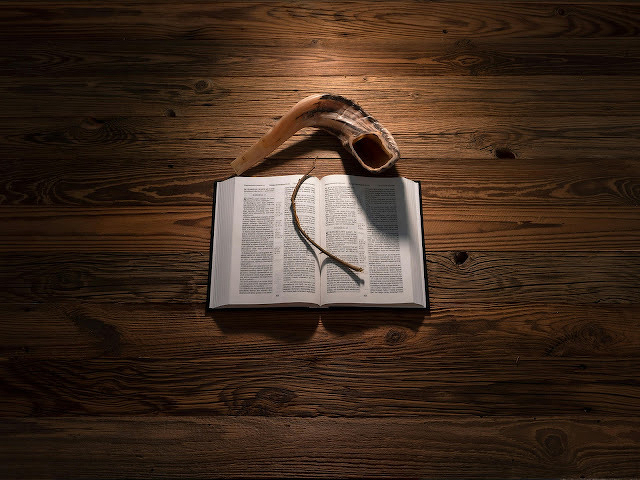
Shana Tovah, mishpascha. It's almost Rosh Hashanah, which means it's time for the annual ritual of seeing how long the oldest person in temple can blow a shofar without passing out. Also time to stock up on Cheerios for Tashlich—because bread is bad for birds and fish and our local DNR rep ok'd the Malt-o-Meal stuff.
As we stumble toward year 5786, this week's Torah portion is Nitzavim ("Standing"), traditionally read on the Shabbat before Rosh Hashanah. The timing isn't coincidental. Like most things in Judaism, it's deliberate, layered, and designed to make you uncomfortable in the most productive way possible.
The portion opens with Moshesummoning everyone—leaders and water-carriers, men and women, children and converts—to renew their covenant with God. It's refreshingly inclusive for a text written millennia before DEI training became mandatory corporate theater. But inclusion here isn't about feeling good; it's about accountability. No one gets to sit this one out because everyone contributed to whatever mess we're in. It's the theological equivalent of a group project where you actually have to participate.
This communal responsibility thing is both comforting and terrifying. Comforting because you're not alone in your failures. Terrifying because you can't blame everything on someone else's poor choices. We're all standing here together, which means we all have to own our part in the year's collection of questionable decisions.
But here's where the portion gets interesting: it introduces teshuvah, the concept of return. Even if you've wandered so far from righteousness that you need Waze to find your way back, the door remains open. Teshuvah isn't just about feeling bad about what you did—guilt is easy and ultimately useless. It's about believing change is possible, which requires a kind of audacity that's either deeply spiritual or mildly delusional. Probably both.
This is what makes the High Holidays more than an extended exercise in collective self-flagellation. Yes, there's judgment, but there's also renewal. The shofar blasts aren't just wake-up calls; they're invitations. The gates of return are always open, which would be more reassuring if most of us weren't so committed to ignoring clearly marked exits.
Then there's the famous injunction to "choose life"—and no, this isn't where we pivot to contemporary political rhetoric that's appropriated religious language for decidedly non-religious purposes. The Torah's version of choosing life is more complex and demanding than any bumper sticker slogan.
Choosing life here means affirming life's sanctity through acts of kindness, justice, and compassion (and *cough* empathy). It's active, not passive. It's not enough to simply not die; you have to actively choose what makes life worth living. For yourself, yes, but also—and this is the uncomfortable part—for future generations. "So that you and your descendants may live." Your choices have consequences that outlast your own convenience.
This is where teshuvah and choosing life converge. Return is the process of realigning yourself with what's life-affirming. It requires taking honest inventory of the past year—which actions brought blessing and which brought harm—and then having the courage to turn toward something better. It's deeply personal work that's simultaneously communal, which is very Jewish: individual responsibility that only makes sense in context of collective obligation.
As the new year approaches, Nitzavim offers both challenge and hope. We've all made choices this year, some better than others. The portion doesn't promise that return is easy—Moshe is talking to a people about to lose him and enter an uncertain future. But it insists that return is possible, and that the choice to affirm life remains ours to make.
The shofar calls, the gates open, and we stand together, imperfect and accountable, ready to try again. It's not a particularly comfortable position, but comfort was never the point.
Tekiah, Shevarim, Teruah, Tekiah Gedolah.
On Not Getting Over It
I had a spectacularly shitty week. It was the kind where Murphy's Law decides to throw a block party and invite all the worst neighbors.
First, I narrowly avoided something I'll call Miserable Thing—a looming catastrophe I'd been preparing for with the obsessive thoroughness of a doomsday prepper. I had Plans A through F, complete with sub-bullets for modifications. I'd closed my eyes at night and seen Miserable Thing heading toward me like a light rail. I went to Shabbat services and spotted it across the social hall, casually noshing on matzo. It haunted me until the day it simply skipped me and hit someone else instead -- someone who didn't deserve it any more than I did.
Then I got what was presumably an illegal Covid shot (don't ask how), had a nuclear immune reaction, and spent the next day glued to my couch like a fever-addled lamprey. Following that, I took an edible that was apparently engineered by the CIA, watched my thoughts detach from my skull and perform aerial maneuvers around the ceiling fan, and generally questioned every life choice that led to that moment. The week's grand finale came when someone I care about accidentally said something cruel enough to sting for days.
The only bright spot? The Naked Gun remake was pretty decent.
You'd think dodging Miserable Thing would bring relief. Instead, I found myself drowning in guilt—that particular Jewish craft where surviving something is akin theft. I kept remembering seventh grade, when I won a bag of store-brand popcorn for finishing an assignment first. The triumphant march to collect my prize morphed into a death walk back to my seat, accompanied by a chorus of classmate disapproval. I opened that bag and passed it around desperately, hoping shared wealth might restore my social standing. Because nothing explains adult anxiety about success quite like being an unpopular twelve-year-old.
Somewhere between the Covid fog and the cannabis mishap, my friend delivered this gem: "Maybe you need to get over your trauma."
Ah yes. Get over it. Why hadn't I thought of that? Forty-one years of accumulated damage, years of therapy, medication adjustments, and carefully constructed coping mechanisms—and the solution was simply getting over it this whole time. Brilliant.
Look, I understand that traumatized people can be exhausting. We come in various difficult flavors: the perpetually fragile who require constant gentle handling, the hard candy shells with soft centers that crack unexpectedly, the pressure cookers that explode when you're not paying attention. Sometimes it probably seems easier to just avoid us entirely rather than navigate our particular brands of brokenness.
But here's what I've learned after years of expensive therapy: trauma doesn't disappear. It doesn't pack its bags and leave after you've processed it sufficiently or reached some arbitrary milestone of functionality. Trauma is more like a permanent dysfunctional roommate—one you learn to live with, set boundaries around, and occasionally negotiate with when it gets too loud.
I think of myself as a volcano. All the anger, hurt, frustration, and fear I was told to bottle up stays deep in my core, churning like molten lava. I keep it contained until everyone least expects it, then erupt like Vesuvius, leaving people to wonder why I never mentioned I was upset. The answer, of course, is that I mentioned it constantly—just not in ways anyone recognized.
Therapy taught me that processing trauma doesn't mean pushing through it or achieving some pristine state of being "over it." It means understanding that this happened to me without letting it define me entirely. It means knowing why certain situations feel impossible, why some events make my skin crawl, and how to establish boundaries that keep me functional. Most importantly, it means accepting that I don't have to heal on anyone else's timeline.
The good news is that after this parade of awfulness, I'm still here. The Covid funk lifted, Miserable Thing is in the rearview mirror, and the person who suggested I get over my trauma has since apologized. I'm sleeping soundly again, at least until the next inevitable rough patch.
Because there will be a next time. Bad weeks happen to everyone, but some of us just have more elaborate internal weather systems. The difference is that now I know I can withstand it—not because I've transcended my damage, but because I've learned to work with it instead of against it.
And sometimes, that's the best any of us can do.
Confessions of a Reformed Pilates Skeptic

Five years ago, if you'd told me I'd become someone who voluntarily contorts themselves on dicey-looking contraptions while an instructor cheerfully suggests I "breathe into my pelvic floor," I'd have gone to therapy sooner. Yet here we are, and like all good conversion pieces, mine began with the pandemic.
(Note: the picture above is NOT me. It's AI-generated -- sorry. But I did so as an experiment to see how well I could prompt it into creating an image of me doing Pilates. Results: kinda weird!)
March 2020 arrived with its familiar apocalyptic fanfare, and I made the same calculation as millions of other suddenly homebound humans: if I'm going to be trapped indoors indefinitely, I might as well do something productive before my inevitable descent into madness. So I bought a rowing machine and began what I now cringe to call my "Fitness Journey"—a phrase that makes me sound like someone whose personality revolves around kale smoothies and unsolicited rep counts. For the record, I do write books. It's just that nobody asks about those at parties.
Within months, I was cobbling together routines from YouTube and Apple Fitness Plus, including something called Pilates—a word I'd only heard whispered mockingly about suburban moms in designer athleisure queuing for classes like they were waiting for limited-edition handbags. But I needed core strength, and mine was demonstrably theoretical at the time.
The results were undeniable: forty pounds lost in nine months, though I credit a combination of movement, medication changes, and the general apocalyptic stress of existing in 2020. Still, when a Pilates studio featuring what can only be described as torture devices disguised as exercise equipment opened in town, I was intrigued. These "Reformers" look like something from an S&M dungeon, but I'd learned that Pilates was originally created and practiced on an apparatus—Joseph Pilates developed his method for bedridden WWI soldiers using springs and dowel rods, because apparently nothing says "rehabilitation" like contraptions that resemble medieval siege engines. Nobody expects the Spanish Inquisition, indeed.
One class convinced me. Where had this been all my life? I signed up for a membership faster than you can say "three-month commitment."
Now, before you conjure images of that SNL sketch, let me dispel some persistent myths about this particular form of sanctioned masochism:
Myth 1: Pilates is either impossibly hard or laughably easy.
Neither is true. Pilates is precisely what your body needs it to be—a methodology that combines stretching with resistance training, adaptable to whatever physical disaster you're currently managing. You won't find screaming instructors hurling tires or anyone puking from burpees, but you also won't find gentle stretches accompanied by whale sounds. Your muscles will work, your core will engage, and you'll discover stabilizer muscles you forgot existed. It's challenging without being punitive, which is refreshing in a culture that treats exercise like penance.
Myth 2: Pilates is a "women's workout."
This one's particularly galling given that Pilates literally invented his method for injured male soldiers. The current female-heavy demographic is pure marketing—the fitness industry has simply figured out that women are easier targets for body-improvement messaging. We're more susceptible to "You're not enough, but this expensive thing might fix you" advertising, whether it's Pilates, yoga, or whatever boutique torture method is trending. Meanwhile, capitalism cheerfully profits from our collective insecurities while selling us scubas with matching leggings.
Myth 3: You must be conventionally attractive/thin/flexible to participate.
One class will cure you of this delusion. My studio is populated by every conceivable body type, fitness level, and age bracket. There's an older gentleman who keeps up with the class, soccer moms in oversized t-shirts, former dancers, and people who clearly just wandered in from their couch. Everyone gets corrections, modifications, and the occasional gentle reminder that showing off your splits during leg circles isn't actually the point. The beauty of a room full of people concentrating on their own movement is that no one has time to judge yours.
Myth 4: The equipment looks like sex/torture devices.
Okay, this one's completely accurate. While the Reformers are unsettling, the Cadillacs are worse. You can even hang from them. I can only make so many excuses, but then there's the fuzzy leg cuffs (which I've used before). No way to talk out of that. And don't knock it until you try it.
The real revelation isn't the physical transformation—though my core could now probably survive a minor earthquake. It's the unexpected joy of movement that doesn't feel like punishment, the strange satisfaction of micro-adjustments that create macro-changes, and the discovery that I genuinely enjoy something I once mocked.
Which brings me to my latest plot twist: I'm training to become an instructor. Look: when life hands you a global pandemic and some spare time, you don't just find a new hobby—you prepare to evangelize about it to other skeptics who think they're too up-their-own-ass to try.
On Writing Terrible People: The Themes Behind "I Fucking Hate You"

I titled this blog "Between Books Right Now" as a cheeky excuse to procrastinate while working on my novels. But lo and behold, this summer I published my fourth book, I Fucking Hate You. A couple weeks ago, it hit paperback. Since I have a moment to breathe—and hopefully your undivided attention—I thought I'd discuss it in hopes you'll find it interesting enough to buy, read after buying, and perhaps give my other books a shot while you're at it.
I Fucking Hate You follows two friends, Kate and Rachel, whose relationship implodes after a girls' night gone catastrophically wrong. I've written it from alternating perspectives, starting with the inciting incident (literally called, "The Incident") and continuing through the wreckage of the year that follows. This structure lets you see what each character omits, what they refuse to hear, and how they're unreliable narrators to each other and to you. It's a dark melodrama with emphasis on dark—both protagonists are unlikable, unscrupulous, and unpleasant people who choose self-destruction over the radical act of having a conversation.
The easiest solution is always "why don't they just talk to each other?" But they can't. They're too miserable.
I'm hoping you'll laugh along because some of these situations are ridiculous and unbelievable. I wrote Kate and Rachel to be over-the-top with their venom and lack of self-awareness—like Joan Crawford and Bette Davis fighting over a dead bird on a silver platter. I want you to side with neither and both of them simultaneously. I want you to hate them and feel sorry for them in equal measure.
Since I'm not popular enough to be invited to conventions or give talks, I'm writing out my themes here in hopes this reaches someone someday. Also: slight spoilers ahead if you haven't read it yet.
Toxic Friendships (Or: The Art of Emotional Vampirism)
Kate and Rachel don't begin the novel as friends, though they insist throughout that they've been close since college. They're passive-aggressive to each other, speak poorly about each other to their spouses, and view their relationship as purely transactional. Kate sees Rachel as her designated shoulder to cry on about her mother's death; Rachel needs Kate as emotional support for her adoption struggles. Neither confides their real issues—money troubles, marriage problems, in-law drama, and worst of all, crushing dissatisfaction with their lives.
But Kate and Rachel aren't the only toxic friendship in the novel. Kate's relationship with her trendy theater friends, Louis and Faye, is arguably worse. They happily supply her with recreational drugs despite her known heart condition (if you've read my first book, congratulations—you spotted a Clout reference). When she has a heart attack, they abandon her like she might be contagious. From Rachel's perspective, they're outwardly cruel to Kate even when she's present.
Then there's James, Kate's boss at SACC. Their "friendship" exists in that gray area where Kate might be projecting feelings that aren't reciprocal, James might be leading her on, or they might actually ride off into the sunset together. The bottom line: Kate is sick, lonely, vulnerable, and has zero concept of healthy relationships. No matter the outcome, it's going to implode spectacularly.
Rachel, meanwhile, can't form friendships with women because she's too busy being envious of them. It starts small—daily battles with moms at preschool pickup—then escalates to her sisters-in-law, who don't even have names in her mind, just "the Viper" and "the Honeydew Melon."
Her half-sisters bear the worst of it. Holly, on her mother's side, genuinely wants to include Rachel in her life. But Rachel is steadfast in hating her, mostly to punish her mother for divorcing her father. She also silently accuses Holly—a teenager—of going after her husband. Whether this is true remains intentionally vague, but it's another layer of Rachel's paranoia.
On her father's side is long-lost half-sister Leah (née Robyn). Unlike Holly, Leah wants nothing to do with Rachel and actively avoids her. Rachel, however, is convinced they can be friends, ignoring that Leah's existence caused her family's original fracture. Determined to control her narrative regardless of who gets hurt, Rachel barrels through Leah's boundaries and ruins another opportunity for self-awareness.
Unreliable Narrators (Or: When Everyone's Wrong)
Writing from two POVs was challenging, but it gave me a creative way to cast doubt on who deserves more sympathy. From the Incident to their final meeting, Kate and Rachel's accounts vary in nuanced ways. This doesn't make them liars—it makes them human. They have different perceptions of the same truth.
What originally inspired this book was a similar event in my own life. To keep it brief: I had a terrible time, my friend did not. I stewed for weeks over this "Incident," ready to end the friendship because my entire opinion of them had changed. Then they contacted me out of the blue to say how much they'd enjoyed spending time with me, couldn't wait to do it again, and hoped I'd had as much fun as they did.
My mind exploded. What the fuck? They had fun? I was miserable! Could it be that I wasn't the only person in the world experiencing things, and—gasp—other people experienced them differently?
There are always at least two perspectives. What's fun and games for some might be a night in hell for others. It's human nature to see things selfishly, and when I realized that, I knew I had to write this story from two perspectives.
While Kate and Rachel aren't meant to be likable, they had to be empathetic. If readers hate both characters, I won't win them over. So regardless of the alternating POV, both women remain sympathetic. Kate is sick, grieving her mother, struggling in her marriage. Rachel is infertile, also grieving her mother, overwhelmed by motherhood. Even at their worst, neither should be condemned for their feelings. Kate faces a bleak future and lashes out; Rachel buckles under the pressures of motherhood. Both feel abandoned and don't know how to process it. Both hate how marriage has defined them.
Had I given Kate more first-world problems or made Rachel more of a trad-wife stereotype, this wouldn't have been a novel so much as a MAGA instruction manual.
Each character gets to destroy the other once during their climactic fight. They go after each other's biggest insecurities: Rachel tears Kate down for being boring, for losing the interests that once defined her, for exploiting her own grief, and—worst of all—for amounting to nothing but a housewife after all her grand plans. Kate rips into Rachel for being delusional about motherhood's joys and reminds her she never wanted to marry Dan in the first place.
This cuts to what each woman knows about herself: Kate has accomplished none of her life goals, and Rachel only got married and had children to repair her own childhood damage.
Ironically, the only time I made sure their POVs aligned closely was during their final meeting—when they say goodbye forever. Even then, there are differences in who gets the last word. Rachel looks good in her own story; Kate comes out on top in hers. We all write our own narratives and make ourselves the heroes. Neither character was going to let the other hurt them without one final response.
The title, I Fucking Hate You, is what they scream at each other during the novel's climax. So much hurt, resentment, and anger gets dumped out in that moment. But the truth is, Kate and Rachel don't hate each other. There's nothing substantial enough to hate. They're both the same—two women with marriage troubles, missing their mothers, dealing with health issues who go out for a night and don't have a good time.
That sucks, but it's not hatred-worthy.
The truth is, when they scream "I fucking hate you," they're not talking to each other. They're talking to themselves.
Parashat Eikev: Remembrance of Things Past

This marks my last weekly d'var Torah essay for the summer—not because I'm abandoning Torah study (God forbid, literally), but because I'm shifting focus to my very Jewish novel and exploring different essay territories. Think of it as a sabbatical from weekly biblical commentary, not a divorce from discussing the particular joys and neuroses of Jewish life.
I'm going out on Parashat Eikev, which feels appropriately anticlimactic. Moshe is still delivering his farewell address to the Israelites—imagine your grandfather at Thanksgiving, except instead of stories about walking uphill both ways to school, it's remember that time you built a golden calf and nearly got us all smited? The man has commitment to his talking points, I'll give him that.
Eikev reads like a greatest hits album of Israelite failures, which immediately brings to mind that brilliant song from Crazy Ex-Girlfriend: "Remember That We Suffered." Picture Tovah Feldshuh and Patti LuPone in minor key, dancing the hora while cataloguing generations of Jewish trauma. It's peak Jewish entertainment: turning collective memory into musical theater with just the right amount of self-deprecating humor.
But Moshe isn't just being repetitive for dramatic effect. Throughout this portion, he commands the Israelites to "remember" or "do not forget" with the intensity of someone who knows his audience has the attention span of goldfish. This isn't new territory—he's previously warned against the spiritual dangers of selective nostalgia. Memory, in Jewish tradition, isn't passive reminiscence; it's active moral discipline that shapes humility, gratitude, and ethical responsibility.
The Golden Calf incident gets another rehashing, along with various rebellions and general acts of collective stubbornness. Yes, it's uncomfortable. Yes, shame is involved. But that's precisely the point. Remembering history honestly—the failures alongside the triumphs—brings humility. If we curate our memories to include only victories, we risk moral blindness and the kind of arrogance that thinks we're invincible.
(This applies beyond Jewish history, obviously. American exceptionalism has entered the chat.)
But Moshe balances this harsh reckoning with reminders of blessings, which serves as gratitude training. There's a reason Jewish liturgy is heavy on blessings—as I said last week, we have prayers for everything. Birkat HaMazon, the prayer after meals, thanks God for food, land, Jerusalem, and divine goodness. It's ritualized gratitude designed to prevent entitlement and remind us that abundance isn't purely self-made.
The second half of the Sh'ma appears in this portion too, with its instructions to bind these words on our arms and foreheads, teach them to our children, fix them to our doorposts, and speak them daily. This isn't metaphorical—it's about creating tangible reminders because memory fades without physical anchors. We call this zikaron, active remembrance. You see it at Passover seders, in Kiddush, in movements like Zachor B'Salon to preserve Holocaust memory. Memory requires maintenance.
I study these portions weekly and Mishnah daily partly because my memory is Swiss cheese, but mostly because I want to understand the narrative of my ancestors. These stories—historically accurate or not—are gateways to collective memory. And since this parashat is all about remembering, what I want to retain from it is this: forgetting leads to arrogance and identity loss. Memory functions as both individual moral discipline and communal anchor, revealing uncomfortable truths about our failures while affirming the reality of our blessings.
Next month brings Elul, the Hebrew year's final stretch before the High Holy Days. It's prime time for personal inventory—not to wallow, but to extract lessons worth carrying forward. Moshe understood that the point of remembering isn't to stay stuck in the past, but to enter the future with clearer vision.
These weekly essays have been an unexpected joy this summer—an exercise in staying connected to community while learning something new to share, regardless of readership size. Sometimes the best conversations happen when you're not sure anyone's listening.
Sydney Sweeney, American Eagle, and the Banality of Corporate Evil
I've been trying to craft a sufficiently wry response to American Eagle's recent eugenics-adjacent advertisement featuring professional pretty-person Sydney Sweeney, but I keep circling back to the depressing mundanity of it all. Here's a clothing company that my middle-school self desperately wanted to shop at—had I possessed both the allowance and the social capital—partnering with an actress whose relevance seems to exist in inverse proportion to her actual talent. There's something perfectly American about this pairing, and I don't mean that as a compliment (or a pun).
The ad itself presumably began with a conference room full of white MBAs congratulating themselves on their "genes vs. jeans" wordplay, complete with references to eye color and a callback to Brooke Shields' Calvin Klein campaign. Someone should have interrupted this mutual circle jerk to ask whether invoking genetic superiority while advertising denim might land somewhere between "ill-advised" and "historically unconscionable," but apparently that someone was taking a very long lunch.
I'm not going to rehash the well-documented history of eugenics or explain why Sweeney's scripted musings sound like white supremacist dog whistles—that requires more energy than my usual snark allows. Nor will I catalog the ways Brooke Shields was exploited as a minor, making any reference to her infamous campaign an entry for advertising's Do Not Do list. But I will note that American Eagle kept the ad up long enough to see who rallied to its defense: white supremacists, racists, anti-Semites, and their various political enablers. If "you are the company you keep" is my first rule in life, my second is "if I wouldn't take advice from you, I sure as fuck wouldn't take criticism from you."
When the predictable backlash arrived, American Eagle issued a half-hearted apology claiming it was "all about the jeans." Which is both true and utterly beside the point—it wasn't about their product so much as their quarterly projections. The company I once viewed as the sophisticated alternative to Abercrombie & Fitch (the cool girls shopped A&E; the insufferable ones went to A&F) now sits in mall limbo alongside the corpses of H&M, Forever 21, and other fast-fashion casualties. They know they're dying a slow retail death, so why not manufacture some controversy for short-term gains?
And it worked. Stock prices jumped, inventory moved, mission accomplished.
All of this sturm und drang over ill-fitting jeans that Sweeney was ostensibly hawking for charity—though you'd never have known about the charitable angle since it got buried beneath the genetic superiority messaging. Priorities, apparently.
I'm not particularly fond of Sweeney's acting, though I adore Euphoria (yes, even the second season—fight me). She's arguably the weakest performer in an otherwise stellar ensemble, her storyline the least compelling, but she does what she can with her limited range. Then again, mediocre actors succeed all the time. For every Sydney Sweeney, I can name five men with equivalent talent and superior acclaim: Robert De Niro playing himself in perpetuity, Leonardo DiCaprio's wooden earnestness, Jack Nicholson's shameless mugging, Nicolas Cage's theatrical overreach, Matthew McConaughey's accent-limited charm. All Oscar winners. All coasting on charisma and good timing.
The misogyny directed at Sweeney is palpable and predictable—she's attractive, amiably nude, politically neutral, and theatrically unremarkable. She's set herself up as a lightning rod for resentment simply by existing in public while possessing breasts and ambition.
There's nothing inherently wrong with leveraging your assets for advancement. She wants to sell bathwater-adjacent soap? Fine. Lingerie for an audience of men who don't buy lingerie? Whatever works. Sydney either understands her brand or she's being expertly managed—probably a bit of both. But here's where my defense ends: there's a problem with lending your image to campaigns that flirt with racial superiority, and there's an even bigger problem with treasuring your political neutrality so much that you remain silent when literal Nazis praise you. Unless, of course, she's fine with that endorsement.
Here's the thing about modern celebrity: we've reached the point where famous people aren't really people anymore. Unless they've survived decades in the business, they're brands with heartbeats, and brands don't have consciences—they have profit margins. I don't understand why we expect Sydney Sweeney or any celebrity to possess morals and ethics when they're primarily running businesses. The parasocial relationships we form with fame are baffling—as if we expect our favorite pretty people to align perfectly with our values simply because they're pretty and in things we enjoy watching.
But Sweeney will be fine. She'll continue booking work until Hollywood decides she's too old at thirty-five, and hopefully she'll have diversified her Nazi denim money sufficiently to retire comfortably. The rest of us will find new celebrities to project our expectations onto, American Eagle will continue its slow fade into retail irrelevance, and somewhere in a conference room, another group of white MBAs will congratulate themselves on their next brilliant campaign.
The banality of it all is perhaps the most depressing part—evil doesn't always announce itself with dramatic flourishes. Sometimes it just wears jeans and calls itself marketing.
Parashat Vaetchanan: Everything about Judaism is the Sh'ma

Jews have a prayer for everything. Bread, wine, candles. The hurting, the dead. Hell, there's even a prayer for after sex—yes, this is real[1]. If you can think of it, there's a prayer for it. And if there isn't a prayer for it, there's a meal for it. What prayer can't heal, a good chicken soup can.
But if there's one prayer that serves as Judaism's greatest hit—our equivalent of a chicken soup declaration that covers everything—it's the Sh'ma. Front and center in this week's Torah portion, Parashat Vaetchanan, the Sh'ma gets repeated constantly and emphatically throughout our services. We're supposed to recite it daily, in times of stress, and in relief. Sh'ma Yisrael, Adonai Eloheinu, Adonai Echad. Hear, O Israel, Adonai is our God, Adonai is One.
But why this prayer, and why so often? The easy answer is that we're commanded to—but that's the boring answer and I wouldn't be writing a 1000+ word essay on it if that's all there was to it.
Repetition dominates this Torah portion. In Moshe's final, emotional plea to the Israelites, he reminds them what it's like to turn away from God and retells the Ten Commandments and other laws. It's continuation from last week—Moshe is nearing the end of his life, knowingly barred from entering the Promised Land, and recounting the events that brought him and his people to this threshold.
But repetition here isn't redundancy. It's knowledge transmission. Moshe speaks to those who stood with him at Mount Sinai, the emerging generation who weren't there, and—most importantly—us, the readers who must learn all of this from our biblical ancestors. He's building a legacy of people who don't just know the law but internalize it. The Sh'ma shouldn't merely be read; it should be engraved into daily life.
Like my sixth-grade math teacher trying to get me to understand fractions said, "Write this on the inside of your eyelids if you're not getting it." (She was a bitch, but she had a point.)
The Sh'ma carries an affirmation core to Jewish identity that stretches across time and space. "Hear, O Israel" calls for community—not individual attention. "Adonai is our God, Adonai is One" declares radical monotheism with no room for division or compromise.
I've been careful not to drag other religions that preach monotheism while practicing something decidedly more complicated, but here's the setup: Judaism emphasizes steadfast community over individual relationships with God and refuses to budge on this one-God thing. No three-in-one. No "sons of." Adonai is just one.
But the Sh'ma transcends theological declaration—it's a lifestyle blueprint. Following the Sh'ma are the V'ahavta commandments: "Love Adonai your God with all your heart, soul, and might... Impress them upon your children. Recite them at home, when you are away, when you lie down, and when you get up."
Then comes the practical stuff: "Bind them as a sign on your hand and let them serve as a symbol on your forehead"—hello, t'fillin—"inscribe them on the doorposts of your house and on your gates"—enter the mezuzah. Also note: in Jewish folklore, golems were inscribed with the Sh'ma to give them life and destroyed when the Sh'ma was erased.
This isn't abstract. The Sh'ma creates embodied, practiced, physicalized faith—a daily rhythm of mindfulness with visible symbols. Mezuzot and t'fillin serve as spiritual sticky notes of this affirmation.
There's urgency in Moshe's plea, not just because his time is ending, but because he wants the covenant with God to endure. The only path to permanence is repetition. From Moshe until now, the Sh'ma has been the link—its repetition ensures continuity.
Saying it daily, before bed, in crisis, and at death shapes Jewish identity not just through belief, but through memory, ritual, and language. Moshe will die. We will die. But the affirmation and connection persist.
With all the repetition and rituals in Jewish life, the Sh'ma remains the most straightforward—a declaration of loyalty, a spiritual instruction manual for living as a Jew. Just as Moshe repeated these words for the next generation of Israelites, we inherit the task of not just remembering but living and transmitting them.
Whether we wrap t'fillin or affix mezuzot to our doorways, we continue listening to Moshe, even today. Not bad for a prayer that covers everything.
[1] Rotem, Rabbi Efrat. “A Blessing after Making Love.” Mishkan Ga’avah Where Pride Dwells, edited by Rabbi Denise L. Eger, New York, NY, CCAR Press, 2020, p. 40.
The Girls are Alright

Last week, I had my first mammogram. I won't bury the lede—I'm fine. The results arrived the same day, which initially triggered my anxiety ("Why so fast? Something must be wrong"), until I remembered I live in the Year of Our Lady Ms. Rachel, where same-day medical results are standard rather than ominous.
Baruch HaShem. The girls are alright.
The impetus for this overdue appointment was twofold. First, the obvious: after 40, annual mammograms become part of that delightful catalog of routine indignities we call "women's health." I'm fortunate—no family history of breast cancer, negative BRCA-1 and -2 tests. The only genetic gifts passed down to me are neurological issues and a generous helping of mental illness, both of which, thanks to modern medicine and personal choice, end with me.
I postponed last year's appointment, partly because I was hesitant to subject my surgically enhanced breasts to compression so soon after my mastopexy and reduction (a story for another time), but mostly because I was terrified. I didn't want to be the statistical outlier in my family, the one who discovers a malignancy and faces the entire brutal sequence: surgery, chemo, radiation, mastectomy, and the slow dissolution of everything familiar about my body. I didn't want that for myself or my loved ones.
Then, in April, a friend and colleague died from metastatic breast cancer. She was two years older than me.
I spent two weeks sobbing. This woman embodied every quality that should theoretically protect someone from cosmic cruelty—kindness, thoughtfulness, devotion as a wife and mother. She seemed too fundamentally decent to deserve even a head cold, let alone Stage 4 cancer that skipped right over stages 1 through 3 like some malevolent overachiever.
Man, fuck cancer.
Between her death and learning my former boss was also battling breast cancer, I finally called radiology.
The appointment itself proved anticlimactic. A mammogram isn't nearly as horrific as popular culture suggests, though it's certainly no day at the spa. You undress from the waist up in front of a stranger, answer questions about your "breast health history," then lean into a machine that squishes your breasts between two glass plates while taking pictures. Breathe at the wrong moment or develop "wrinkles" (excess skin caught in the machinery), and you get to repeat the process.
My technician channeled Nurse Ratched—not actively hostile, just aggressively indifferent to my polite compliance. Fine. I get it. You do this all day. Thanks for not yelling at me, at least.
The discomfort registers maybe a 4 out of 10 on the pain scale. I've accidentally kicked myself in the chest (pre-surgery) and that hurt significantly more. Plus, I'm admittedly vain about my assets—I paid good money for them to look cute and perky, and I intend to maintain that investment as long as possible.
Nurse Not-Ratched promised results within five business days. They arrived by dinner. I exhaled properly for the first time all day and earned myself another year of reprieve, though self-exams and gynecological visits remain non-negotiable. Strangers examining my body isn't my idea of entertainment, but I'm realistic about the requirements of aging while female.
If you possess breasts, consider this your PSA. Get them checked, especially after 40. October might be Breast Cancer Awareness Month, but awareness should be a daily practice, not an annual publicity campaign. The girls deserve that much attention.
Parashat Devarim: Fear and the Art of Responsible Remembering

This is an important Torah portion, mishpachah! We arrive at Parashat Devarim, which is read on the Shabbat before Tisha B'Av—the minor holiday that marks the destruction of the Temple and has all the festive energy of a root canal. It's essentially Moshe's farewell address to the Israelites before entering Canaan, and before he enters whatever comes after: Heaven, the World to Come, the great IHOP in the Sky. Personally, I'm hoping the afterlife features unlimited Rooty Tooty Fresh and Fruity pancakes, but I'm on a cut and have never been 100% sure what happens afterward.
Full disclosure: I'm focusing less on the portion itself and more on its connection to Tisha B'Av, because holidays are where my amateur status becomes glaringly obvious. I'm not a scholar—I'm just someone figuring out what it means to be Jewish while maintaining a healthy skepticism about my own expertise. If I completely fuck this up, I'll write a correction next year (assuming I haven't been slapped down).
Historically, the Temple fell twice: first in 586 BCE, then again in 70 CE. Jews observe this destruction on the 9th of Av, followed by three weeks of mourning. It's sort of like a shorter and a longer Yom Kippur at the same time. It's a period of reflection on what we lost—not just architecturally, but philosophically. At the heart of both Moshe's speech and Tisha B'Av lies the devastating power of fear and its remarkable ability to unravel a society's future when faith and reason get into a slap fight.
Talmudic scholars argue that the First Great Collapse wasn't actually the Temple. It was the sin of the spies, which Moshe helpfully recounts during his farewell tour. "Remember when you insisted on doing recon work to spy on the Amorites despite my saying God would handle it?" he reminds them. "Yeah, that sucked." That entire generation spent forty years wandering the wilderness, unable to reach the Promised Land. Only Joshua and Caleb made it through—apparently they were the only ones who didn't panic when faced with uncertainty. Menschen, both of them.
It's the original Tisha B'Av: a day of disaster brought on by fear. Despite divine assurances ("God will fight for you") and empirical evidence ("just like God did in Egypt, which you literally witnessed"), fear trumped both faith and reason. The Israelites' terror of the unknown cost them their promised future.
This fear wasn't entirely irrational, though. Constant movement and homelessness after generations of bondage creates the kind of anxiety that turns you into a backseat driver. But Tisha B'Av also asks us to reflect on another type of devastation: the kind that comes from internalized fear.
The Second Temple fell to the Romans after the Jewish rebellion, launching two millennia of fear-based persecution: murder, enslavement, famine, civil war, and ultimately, the Holocaust. Judaism became the world's scapegoat, blamed for everything from market crashes to bad weather. There's no logic behind accusing Jews of controlling global finance or Hollywood (that's just capitalism in a flashier suit), but it's not like logic and antisemitism have ever been besties.
The rabbis have a term for this: sinat chinam—baseless hatred. It's fear of the "other," whether political, sectarian, or ideological. Like the first collapse, the Temple's destruction bred internal fear of communal disintegration. Distrust within the Jewish community made us vulnerable to scapegoating. Tisha B'Av becomes a day to mourn not just physical destruction, but the loss of unity that made us targets.
Rebuilding isn't exactly straightforward. But Tisha B'Av isn't designed as a pity party—it's about clarity. When Moshe addresses the Israelites, he doesn't erase their failures; he confronts them head-on. He reminds them (and us) to rise above fear and rebuild faith and reason from the ground up.
Nostalgia holds us back from rebuilding. Remember, nostalgia isn't the bittersweet memories of high school and college; it's a deep-seated longing or sadness for the past. That sadness roots our feet in place and prevents us from moving on and rebuilding. I've discovered that nostalgia is like alcohol: delightful in moderation with friends, occasionally leading to dramatic sobbing sessions, but problematic when you're getting shitfaced daily and alone. This Parashat advocates for responsible remembering, not nostalgia binging.
Moving forward is terrifying because the future refuses to provide spoilers. But Moshe, approaching his own finale, reminds the Israelites of their support system: his leadership, divine presence during conquests, and promises of continued guidance. They have evidence that rebuilding is possible and that faith provides sustainable growth rather than just wishful thinking.
This makes Tisha B'Av more than a mourning ritual. It's a starting point for reconstruction. The Hebrew word is teshuvah, meaning "return." We grieve what was lost, then focus on rebuilding without fear steering the ship.
Fear has this remarkable ability to override both faith and reason—impressive, considering they're usually at odds with each other. Great fear causes spectacular breakdowns: sending spies despite divine guarantees, blaming Jews for antisemitic conspiracy theories despite substantial research proving otherwise. Fear can unravel even the most reasonable and faithful minds, breeding the baseless hatred that destroys communities.
Fear unchallenged leads to collapse; faith and reason build resilience. Whether another temple will rise in my lifetime remains unclear, but this mourning period has value regardless. We can fast on Tisha B'Av to grieve what fear cost us, then recommit to a future shaped by what we learned from the rubble.
After all, if we're going to rebuild, we might as well do it right this time.
Parashat Matot-Masei: We Live in a Society, Damn It!

Well, we made it to the end of a very long journey. The Israelites are no longer wandering around in the wilderness. They've arrived at Canaan, where they'll settle in happily and peacefully among its inhabitants, with an end to the violence that plagued previous parashiyot. The Promised Land awaits! Milk and honey! Fruit trees! Dogs and cats lying together! Mass...harmoniousness...?
*Checks notes.* Sorry, no. None of that happens.
I know I was particularly unforgiving toward the Israelites in last week's portion. It was dark and bloody, and I'm not about to excuse violence for the sake of conquest—I save my moral relativism for more pressing matters, like whether you should eat Wendy's french fries dipped in a Frosty (ew, no -- don't eat at Wendy's). But it's important to remember that this is a narrative of my ancestors, and more importantly, that these portions offer a meditation on how communities are actually built. While violence can certainly be part of that process (see: most of human history), so too can speech, memory, justice, and inclusion. Revolutionary concepts, I know.
Maybe it's wishful thinking or simply the desire to find meaning in ancient texts, but a society—especially one that aspires to holiness—isn't created through conquest alone. It's shaped by how it speaks, remembers, and listens. Which, frankly, suggests we're all in more trouble than previously anticipated.
In the opening of Parashot Matot, God lays out the laws of vows and oaths—both personal and divine. What strikes me as peculiar is that whether a man makes a personal oath or one to God, he must keep it. Period. It's a demand for accountability regardless of intent, convenience, or the very human tendency to make promises we can't keep after our third glass of wine.
Promises, vows, oaths, basic honesty—speech binds a society together. There's little point in having a shared community where there's no accountability for breaking your word, whether to yourself, your neighbor, or God. It's a reasonable foundation, assuming anyone actually plans to follow through.
But as usual, this society comes with an asterisk the size of Mount Sinai when it comes to women. Under the control of their fathers or husbands, women don't carry the same obligation regarding vows and oaths. We're also apparently off the hook if no one heard us make the promise in the first place. On one hand—fantastic! I promised to do laundry yesterday, but I'm fairly certain neither my father nor spouse was within earshot. Now I'm out of grip socks for Pilates, but technically blameless.
However, this represents a deeply paternalistic approach that effectively excludes women from full participation in community life. Women aren't even counted in censuses. We take marriage vows that can be overridden by our husbands (put a pin in that). We're simultaneously required to have others speak for us while being silenced ourselves. It's a masterclass in having your cake and eating it too, if your cake is systemic marginalization.
What we promise shapes who we are, and who we are shapes our community. Excluding half the population from that foundational responsibility seems like poor planning, but what do I know? I'm just a woman whose oaths may or may not count depending on who's listening or who's roof I'm under.
Another requirement for any functioning community is justice and mercy, which are qualities the Israelites haven't exactly excelled at thus far. But in Parashat Masei, God commands them to establish new laws, including the creation of cities of refuge.
I first encountered cities of refuge earlier this year during Mishnah Yomit (Mishnah Makkot 2), and the concept fascinated me. These six cities provide sanctuary for accidental murderers—cases of manslaughter rather than premeditated murder. From the victim's perspective, this seems frustratingly lenient. If someone accidentally killed someone I loved, I'd certainly give pause before tracking them down to another city. But then God carefully delineates the differences between murder, manslaughter, and the true meaning of justice.
Of course, most Israelites are guilty of various crimes themselves. Does it seem hypocritical to enact laws for people who are obviously culpable? Perhaps. But before settling into their forty-eight cities, this community wandered, erred, and hopefully grew. Laws aren't created in a vacuum—they reflect experience. A justice system can't be carved from thin air; it must emerge from lived reality. Memory, ideally, creates compassion. That experience of exile and loss shouldn't produce rigid judges but understanding ones.
In theory, anyway. In practice? Well, we're still working on that several millennia later.
To truly cement a community together, you have to include the voiceless. So let's return to that pin about women.
Tzelophechad's daughters (the spelling varies depending on which Torah translation you're reading) return to the narrative, and I'm delighted they do. Until I really studied these portions, I'd never encountered them before, which is a shame because they deserve significantly more attention.
These five women approach Moshe about their inheritance rights and—miraculously—in the very next portion, they receive what they ask for. Of course, they must marry within their tribe, Menasseh, to prevent losing their inheritance, because patriarchy never met a victory it couldn't snatch. But still, progress is progress.
It's difficult to overstate this point: inclusivity matters, especially for those historically silenced. It's fundamental to building ethical and spiritual wholeness. When a community genuinely includes everyone, it creates opportunities for growth that wouldn't otherwise exist. Once again -- revolutionary thinking. Someone give me the Nobel Peace Prize.
The parashiyot conclude on a surprisingly optimistic note: the Israelites slowly coalescing around sacred speech, compassionate justice, and expanding inclusivity. They're ostensibly ready for the Promised Land (let's pretend for a moment we don't know how that turns out) precisely because they've learned from their years of exile and wandering.
It's both bittersweet and sobering to reflect on this hopeful vision and compare it to our present reality, both as individuals and as members of larger communities. Do we honor our words? Do we approach justice with compassion rather than vengeance? Do we amplify the voices of the marginalized, or do we ignore and silence them? What are we actually learning from our collective wandering?
These aren't merely ancient questions—they're devastatingly contemporary ones. Only by genuinely learning from our time in various wildernesses can we hope to build communities worthy of inheritance. Whether we're capable of such learning remains an open question, but at least the blueprint exists.
Even if we're still figuring out how to read it.
The Coldplay Affair and My Mother's Office Drama

By now you've seen the viral footage of Astronomer's (now ex) CEO Andy Byron and his HR director caught mid-affair at a Coldplay concert. The schadenfreude is delicious. How phenomenally stupid do two lovers have to be to fuck around at a massive public event, only to find out when they awkwardly dive for cover like teenagers caught necking in the church parking lot? Clearly, these two were amateur hour philanderers! Seasoned affairs either master discretion or learn to conduct their business in plain sight with the confidence of a sitting president.
I don't condone infidelity, naturally. But I do love mess, and as far as your relationship trainwrecks go, they're yours to ruin, mine to witness. This particular story hits my sweet spot: a tech CEO and the head of Human Resources, two people who should theoretically understand professional boundaries. Once upon a time I worked in HR, and I've extended considerable grace to that beleaguered profession. HR professionals are overworked, overwhelmed, and chronically underpaid, forced to babysit misbehaving adults while protecting companies that view them as expendable. But my sympathy evaporates when the head of HR starts bonking the head of the company. I'd call it a conflict of interest, but it sounds like they had several interests perfectly aligned.
My mother also loves mess, though with a crucial difference: I'm content observing from the sidelines, while she prefers creating chaos and inserting herself directly into the drama. Every evening during my childhood, she'd return from her law firm job with a breathless recap of office intrigue. "So-and-so got her boobs done!" or "The senior partners are at each other's throats again!" She'd chatter at breakneck speed while her soup grew cold, my father and I exchanging uncomfortable glances as my elementary school-aged brother constructed snowmen in his mashed potatoes.
Our discomfort stemmed from two sources. First, we had no context for her cast of characters. Dad would venture, "Oh, Sally—is she the one with the new boobs?" Mom would bristle: "No! She's the one whose husband left her. Don't you remember?" Dad would apologize for his inability to track her soap opera, which only frustrated her further.
These people weren't colleagues to her—they were characters, checker pieces to manipulate in her ongoing narratives. When we failed to follow her plots, she'd storm off to sulk in her bedroom before eventually emerging, pretending nothing had happened.
The second source of our horror: Mom didn't just observe these tiny dramas—she actively participated. "My boss's secretary is having boyfriend troubles," she'd announce, "so I told her to dump him."
"Maybe you shouldn't get involved," Dad would suggest.
"Why not? He's clearly a jerk!"
"Because you work together. It's not a good idea."
"Please. She'll thank me later."
The secretary did not thank her later. The secretary married her "jerk" boyfriend and failed to invite my mother to the wedding. Mom was devastated.
"I thought we were friends!" she wailed.
"You told her to leave him," Dad pointed out gently.
"That was ages ago! Everyone else got wedding invitations!" She slumped dramatically. "I think I need a new job."
Which brings us to the Affair Incident.
At one of her final positions before abandoning law entirely, Mom became convinced her boss was conducting a long-term affair with a senior partner. The way she described it, it was the classic I won't leave my spouse but I can't quit you territory. The entire office allegedly knew, but everyone maintained professional silence.
"Isn't it scandalous?" she asked, practically vibrating with excitement. "The highest-paid employees, romantically entangled?"
"No," Dad said flatly. "And you need to stay out of this entirely."
"What?" Mom looked genuinely wounded.
"It's none of your business. Or anyone's business. They're adults. Just do your job."
She turned to me desperately. "You find this interesting, right, honey?"
I blushed, torn between teenage curiosity and parental loyalty. "Affairs are wrong," I said, dutifully toeing the moral line, "but maybe Dad has a point?"
"What's an affair?" my brother asked, systematically dissecting his green beans.
"You always take your father's side!" Mom huffed before making her familiar exit.
For months, she ignored our advice completely. Daily updates flowed: someone spotted them in flagrante in the supply closet, they held hands walking to their cars, they left the holiday party together. Mostly unverifiable gossip that could have described any two people who happened to be in proximity.
Then the tone shifted.
"My boss criticized my interrogatory today," Mom reported one evening, "so I went to the senior partner for a second opinion. He approved it. She didn't appreciate that."
Dad and I shared another look.
"I think she's jealous," Mom laughed. "She thinks I'm after him!"
"Are you certain they're actually having an affair?" Dad asked carefully.
"Obviously. Everyone knows—"
"Everyone knows? With evidence? Or just rumors?"
Mom went quiet for a beat.
"So now I'm a liar?" she demanded, face flushing. "Does no one in this house believe me?"
"I don't think you're a liar, but you're too invested in this. And it's becoming strange."
This time she yelled something about disrespect before storming off. When she was gone, Dad looked at me expectantly, but I just shrugged. I was a teenager; this was merely one episode in her ongoing series of dramas.
The inevitable conclusion arrived on a frigid winter day.
"Fired?" Dad exclaimed.
To make an already long story short: it wasn't her boss who terminated her—it was the senior partner himself. Mom had passive-aggressively confronted him about the alleged affair.
"I said, 'Certain situations here make it hard for me to perform my job effectively.' He asked me to elaborate. I said, 'Oh, you know. You and her?' His face went red and he said, 'I think you're finished here.'"
I expected Dad to launch into a righteous lecture about staying in her lane. He'd been correct all along—she'd gotten too involved and torpedoed herself.
But here's the thing: her boss and the senior partner might have simply been colleagues. Those "obvious" signs could have been professional collaboration misinterpreted by an office full of bored gossips. Mom may have destroyed her career chasing phantoms.
I think about this adolescent memory whenever workplace affairs go public, sparked again by Astronomer's Coldplay catastrophe. Because what if her boss and the senior partner were having an affair? What if they thought they were being discreet while their entire staff catalogued their every interaction?
The lesson here is simple: there is no discreet way to conduct an affair. You're going to get caught, whether by your busybody coworkers or by Chris Martin's kiss cam. The only winning move is not to play.
Parashat Pinchas: Violence, Inheritance, and What We Leave Behind

We're approaching Tisha B'av, the annual reminder that the Temple in Jerusalem has been destroyed not once but twice. The first time was by Nebuchadnezzar in 586 BCE; the second time by Titus in 70 CE. It's been razed for nearly two thousand years, which gives us plenty of time to wonder: what happens if/when we rebuild it? Would we return to the Old Ways of worship, complete with their impressive body count?
I thought about this question as I worked through Parashat Pinchas, though I'm starting at the end because I'm procrastinating on the harder parts. Once Moshe names Joshua as his successor, we're treated to a detailed calendar of offerings and rules for the holidays. Take Pesach alone: eat unleavened bread for seven days, don't work, present a burnt offering of two bulls, a ram, and seven unblemished lambs, prepare meal offerings of flour and oil for each animal, and finally prepare a goat as a sin offering—all on top of your daily burnt offering. Then there are the other holidays. And the regular daily offerings. And the Shabbat offerings.
I'm not trying to make light of this, but that's a staggering number of dead animals. As someone who doesn't eat meat, this portion horrifies me. It's an uncomfortable amount of violence and bloodshed, performed daily, and not just sanctioned by God but commanded by God.
Which brings me back to the beginning of the parashat and our friend Pinchas. After his decisive slaying of Zimri (the Israelite man) and Cozbi (the Midianite woman), God doesn't merely praise Pinchas for his act of violence—God grants him a Covenant of Friendship. "Not only did you end the plague," God declares, "you totally killed my anger against the Israelites, so you and your descendants will be priests forever."
What the hell is this fuckery?
I'm not a biblical literalist, and I take these portions as they're meant to be: stories to learn about my ancestors and (hopefully) something about myself. But if there was ever a case of history written by the victors and justified by zealots, this would be Exhibit A. Immediately afterward, God conveniently tells Moshe to wipe out the Midianites for daring to lead the Israelites astray with their idolatry and "whoring."
To me, this reads like a convenient excuse for said zealotry and violence against another people. Blaming the Midianites for "the trickery they practiced" assumes the Israelites lacked agency and reason. We've read about them making countless mistakes without outside parties "tricking" them into anything. The Israelites can screw up on their own and still recover on their own. Justification for violence is, well, justification.
But speaking of agency, let's talk about a lighter subject: women's suffrage!
Sandwiched between another census of the new generation (tedious to read but important for the transition from emancipation to settling in Canaan), there's a chapter about the five daughters of Tzelophechad—Mahlah, Noah, Hoglah, Milcah, and Tirzah—who take a brave step for women's property rights. They present a compelling argument: "We deserve to inherit our father's property." Their father died in the wilderness leaving only daughters, no sons, but they don't want their father's name to die just because he had no male heirs.
I emphasize their bravery because they go before Moshe, Eleazar, and the entire assembly of temple chiefs—all men—who decide the outcomes of, well, everything. Women have no rights to property; they are property. And yet they not only win their case, but God grants women the right to inherit property if their father has no male heirs.
Yay! Feminism over! We won!
No, this is not a feminist story. Women still have no inheritance rights if they have male siblings. But it is an interesting examination of five women arguing a case for their own agency and winning.
When it comes to inheritance and agency, let's finally address Moshe and Joshua. I've noticed Moshe is a lesser presence in this portion than previous portions. Though he still speaks to God, he's doing less and less. Probably has something to do with striking a stone instead of speaking to it, but regardless, his time is short—both in life and leadership.
This is ending is bittersweet for our beloved Moshe. He'll die before seeing the Promised Land, but he won't leave his people leaderless. God approves of Joshua's leadership, and Moshe is allowed to pass the ceremonial garments to him. It’s a lot to unpack in this transition: Inheritance isn't just what we receive; it's what we leave behind for the next generation.
Moshe led the Israelites out of bondage and through the desert. He outlived his siblings. He withstood rebellions and battles. He built the tabernacle and weathered punishment from God when he disobeyed. And when he looked up to God and begged for death, he was shown mercy. It's more than one man should leave behind. This role isn't easy—the Israelites are a capricious people. But Moshe has the humility and grace to step aside for the next leader to take over.
Did he do so too late? Would he have seen the Promised Land if he had transferred leadership sooner? Who knows. But it's a thoughtful meditation on why leadership is such a powerful position and why so much responsibility falls onto our leaders.
So let me return to my original question: what would happen if the Temple stood again? Would we have mass animal sacrifices and pilgrimages to remind ourselves of communal worship? Would we justify more zealotry in the name of God, telling ourselves we've earned our own covenant?
Perhaps we should take a page from Moshe's book. I think we should look at a standing Temple from a distance, knowing our time grappling with these old ways has come and gone, and that we should bequeath new leadership to the next generation. Call me naive, but I hope for leadership that doesn't insist on violence as proof of devotion and doesn't mistake zealotry for righteousness. And lastly, I hope for leadership that doesn't deny half the population their agency.
The question isn't whether we deserve to inherit the past, but what kind of future we're brave enough to leave behind.
The Myth of Going Home

A few years ago, I committed the cardinal sin of believing Thomas Wolfe was wrong. After nearly twenty years of exile in the South (where the air was thick with both humidity and reactionary politics) I decided to move back home to Michigan (where the humidity and politics weren't perfect but less extreme in equal measure). My intentions -- though noble -- were naturally and completely delusional.
I had constructed an elaborate fantasy in which I would simply slip back into my family's lives like a well-worn sweater, picking up exactly where I'd left off two decades earlier. Never mind that I'd departed as a frightened eighteen-year-old who had never written a check, and was returning as someone who had managed to acquire a marriage, multiple mortgages, and what could generously be called "life experience." The girl who left couldn't balance a checkbook; the woman who returned had a roth IRA. But somehow, I convinced myself that none of this mattered. My brother would still want to play Banjo-Kazooie with me on weekends. My parents would want holiday dinners. We'd all just resume.
What I got instead were closed doors and cold couches.
Don't misunderstand—everyone was happy I'd moved back. There were the appropriate expressions of joy, the requisite "we're so glad you're home" declarations. But happiness is not the same as accommodation. My parents visited my new place twice in the three years I've been back, compared to my several dozen. They didn't even have a guest room when I came to see them, as if my return was theoretical rather than actual. My brother and his fiancée, though genuinely kind, had constructed a life that ran on a rigid schedule of in-laws, friendships, dates, overtime, and LSAT prep. I became the person constantly suggesting get-togethers, game nights, and spontaneous dinner dates. I essentially auditioned for a role in their lives that had already been cast.
I got the occasional puzzle or poker game, but they felt like consolation prizes.
I was appallingly naive to assume my family would exist in stasis, waiting for my return like Sleeping Beauties in their glass boxes. Why would I ever consider that they'd hold everything for me, saving my seat on the public transit of their lives? They were people with ambitions and obligations, not supporting characters in my homecoming narrative. They wanted to move forward with life, not let it pass by around them while they waited for me to figure out where I belonged.
So here I am, grappling with the same question that drove me away in the first place: where do I fit in? Am I the main ingredient in my friends' and family's lives, or am I the garnish—decorative but ultimately optional?
Jesus Christ -- I'm cilantro, aren't I?
I occupy a peculiar demographic niche. I'm too old to hang out with the young ones and most people my age have children, which means their free time exists in fifteen-minute increments between soccer practice and parent-teacher conferences (do parents still do those? I don't know what parents do, tbh). That leaves the sixty-plus crowd, with whom I share exactly two interests: napping and finding young people insufferable. Making friends as an adult is hard enough under normal circumstances; doing it while straddling these particular generational gaps is joining a conversation that's already moved on to the next topic.
But I treasure the friends I do have, even if mine are scattered across the country like dandelion seeds. Mine remember my birthday, and text me memes and old Vines (because we're Elder Millennials now), and they understand that friendship sometimes requires nothing more than just reaching out to say, "Hey." They're proof that connection doesn't require proximity, and that home isn't necessarily a place you return to but something you carry with you.
I just hope they never move on without me, too. Because the truth about going home is that it's not really about the place—it's about the people who make space for you in their lives. And sometimes, the people you thought matter most are the ones who were never there to begin with.
Parashat Balak: Donkeys, Divine Vision, and Really Bad Endings

This week's Torah portion serves up a buffet of discomfort: animal abuse, mass sexual violence euphemistically called "whoring," and divine punishment that makes me wonder if anyone actually likes reading this stuff. Parashat Balak is the kind of biblical text that makes you want to close the book and pretend you're reading something more uplifting, like The Trial.
But before we get to the part that makes everyone squirm in their seats, we need to discuss Balaam—essentially a Level 10 Wizard who min-maxed on spell-casting but rolled a critical failure in basic perception. King Balak hires him to curse the approaching Israelites, which is still better than our current administration's attempts at International Diplomacy. En route, Balaam encounters what might be the most famous ass in literature outside of Charlotte's Web.
(If you expected a Shrek joke, you ain't the sharpest tool in the shed.)
An angel blocks the road. The donkey sees it immediately and refuses to move. Balaam, displaying a type of horror movie situational awareness, beats his donkey three times. The donkey—conveniently female, because of course she is—finally speaks up: "Why are you beating me? Don't you see the angel in front of us?"
It's worth noting that Balaam's reaction to his donkey suddenly developing conversational skills is not shock, but rather a continued focus on his travel inconvenience. This suggests either that talking animals were more common than the text lets on, or that Balaam possessed the kind of tunnel vision that makes people walk into trees and glass doors while texting.
The symbolism here writes itself. The donkey—a creature society deems lowly and expendable—sees what the privileged court prophet cannot. She does her job dutifully, carrying Balaam and his belongings toward Moab, yet gets beaten for trying to protect them both. There's something devastating knowing that wisdom and divine vision come through the voice of the abused, not the powerful.
The angel's intervention serves as both rebuke and reminder: stop taking your frustration out on those who serve you, and maybe you'll actually see what's in front of you. It's a lesson about how anger and entitlement blind us to the sacred, delivered via a conversation between a man and his donkey that somehow manages to be both absurd and profound.
Then we hit the narrative equivalent of a brick wall.
The Israelite men arrive in Shittim—and yes, the name is as fitting as it sounds—where they "profane themselves by whoring" with Moabite women. The text presents this as moral failing rather than what it likely was: conquest and sexual violence. When armies of foreign men suddenly appear in your territory and start "whoring" with your women, enthusiastic consent isn't typically part of the equation. But the biblical narrative seems less concerned with the trauma of the Moabite women than with the Israelite men's subsequent idol worship of Baal Peor.
God's response is swift and brutal: a plague (likely an STI, if we're being practical about it) and orders Moshe to arrange mass execution. Shit hits the fan when one Israelite man brings a Moabite woman directly to the Tent of Meeting—essentially committing sacrilege in the most sacred space. Phinehas, Aaron's grandson, spears both of them through the belly, simultaneously ending the plague and any moral clarity I may have had for this text.
I understand having to read the text as itself, but I also live in the 21st century. Phinehas may be hailed as a hero for bringing an end to the plague, but I feel like its a reasonable ask whether his vigilante execution was really the best available solution. Penicillin would have been more effective and considerably less murderous (but admittedly, it was unavailable at the time).
This is a jarring tonal shift. We go from the darkly comic wisdom of Balaam's talking ass to this brutal religious violence. We're experiencing narrative whiplash, moving from a story about perception and humility to one about zealotry and slaughter. I'm left wondering if these were originally separate texts stitched together by particularly sadistic editor.
Although, that could be the point. Spiritual highs don't prevent ethical lows, and the juxtaposition of Balaam's blessing and the subsequent moral catastrophe suggests that. The same people who receive divine favor can still commit horrific acts (hint, hint, cough, cough). Blessing doesn't equal immunity from moral failure. If anything, it might make the fall more devastating.
The donkey's clear-eyed vision contrasts sharply with the Israelite's spiritual blindness that leads to violence and extremism with the Moabite women. She sees the angel because she has no agenda -- no want for riches or power, and no lust for conquest. The men at Shittim, by contrast, are so focused on their desires and conquests that they lose sight of everything else, including basic human decency. Even Balak first tempted Balaam to curse the Israelites with wealth and riches before God appeared and directed him to speak only what God told him to say.
Parashat Balak forces us to sit with uncomfortable questions about religious violence, divine justice, and the ways power corrupts even the blessed. It's a Torah portion that refuses to offer easy answers or pleasant resolutions. And that's life; sometimes the most profound truths come from the most unexpected voices, and sometimes the most sacred spaces become sites of horror.
I think that's why this portion feels so unsettling for me. It acknowledges that wisdom and brutality can coexist and that our tradition gives us talking donkeys as well as religious zealotry. It's a reminder that even sacred texts don't always tie up their loose ends with neat moral bows.
The donkey, at least, had the good sense to stop when she saw something ahead. The rest of us are still figuring out how to open our eyes.
The Narcissist's Field Guide

When I catch myself ruminating on the nature of being—a pastime that sounds more philosophical than it actually is—I often find myself thinking about the Narcissist's Prayer by Dayna Craig:
That didn't happen.
And if it did, it wasn't that bad.
And if it was, that's not a big deal.
And if it is, that's not my fault.
And if it was, I didn't mean it.
And if I did, you deserved it.
The beauty of this prayer lies in its surgical precision. It maps the narcissist's thought pattern with razor-sharp accuracy. Each line represents a perfectly choreographed sidestep and a lunge away from responsibility and accountability.
After years of therapy—because apparently I needed a professional to confirm what my nervous system had been screaming for four decades—I realized I had grown up in the shadow of a narcissist. The recognition hit with all the subtlety of a brick through a window, which then struck me in the back of my thick, anxious skull.
But here's where things get murky. There's a genuine misconception of narcissism floating around these days, and it's rampant. We have Instagram and TikTok "narcissists"—unseen individuals diagnosed by "empaths" wielding iPhones like medical degrees. The slight of an Internet Narcissist is usually vague and conveniently out of context, ranging from a disappointing partner to a negative encounter at the grocery store.
"He cheated on me and ghosted me! He's a narcissist!"
"She screamed at the cashier! Total narcissist behavior!"
Sometimes we even catch people with false confidence or run-of-the-mill egomania in the crossfire: "She takes a lot of selfies—what a narcissist!" "Look at that narcissist, bragging about his conquests!"
These are not true narcissists. These are Internet Peacocks, flexing for clicks and validation. True Narcissistic Personality Disorder—as diagnosed in the DSM-5, not the DSM-TikTok—operates on an entirely different level. But since I'm not a psychologist, I only feel comfortable describing one through prayer, line by line.
So, let's talk about my narcissist.
That didn't happen.
My narcissist is such an expert in gaslighting, she'd probably claim she invented the technique (if she knew what it was). Every time I've reminded her of the times she hurt me—long past and recent past—she suddenly develops a case of selective amnesia that would impress neurologists.
Picture this: I remind her, "Remember when I was seven and you pushed me off my bike and I broke my arm?" (This is a metaphorical example; this isn't a real one.)
"What? I didn't do that!"
No matter how many times I show her my medical records—the metal rod in my arm, the scar on my elbow, the hospital photos—she refuses to admit it happened. Reality becomes negotiable when you're dealing with a narcissist.
"It did happen, and you pushed me," I insist.
She continues to insist I fell. Despite my repeated reminders of how she chased me down the sidewalk, yelling, calling me names, and literally announcing, "I'm going to push you off your bike!"—she refuses to admit it.
And if it did, it wasn't that bad.
Suddenly, my narcissist's memory makes a miraculous recovery. She remembers me falling off the bike, but the narrative has been sanitized for her protection.
"Oh, you were fine. You had a cast."
"I was in agony. I rode in an ambulance. They had to reset my arm in traction. I was out of school for two weeks. My elbow came out of my flesh."
Facts, it seems, are just suggestions when viewed through the narcissist's lens.
And if it was, that's not a big deal.
"Oh, you're being a baby," she says, employing the classic minimization technique. "You were out of school for two weeks. You didn't have to do homework. You make it seem like you were close to death when all you did was hurt your arm. It was your left arm, too. You could still write. You even got pain pills."
"You took those pain pills," I say. "You said a seven-year-old didn't need them."
The goalpost has moved so far we're playing in a different field.
And if it is, that's not my fault.
I think I've cornered my narcissist now, but she's crafty. She knows how to escape these situations—she's had plenty of practice.
"I don't see why you're blaming me, though," she says. "We were both miserable. There was only one bike and we had to share it. You weren't sharing."
"Need I remind you," I say, "that you pushed me and broke my arm!"
But logic is just another inconvenient obstacle in the narcissist's obstacle course of deflection.
And if it was, I didn't mean it.
She throws up her hands in theatrical despair. "It's not like I wanted you to break your arm! I didn't set out to break your arm when you fell off your bike. I only intended to get you off the bike."
My narcissist starts crying now. She wants me to feel sorry for her—for breaking my arm. The audacity is almost admirable. But this time, I ask her: "Okay, if you didn't mean it—then why haven't you apologized?"
The question hangs in the air like smoke from a extinguished candle.
And if I did, you deserved it.
This is the final nail in the coffin, where my narcissist gets as close as she can to admitting wrongdoing without actually doing so. She doesn't look me in the eye—that would require acknowledging my humanity—she just rolls her eyes and says, "If you had just gotten off the bike and shared it, this wouldn't have happened."
How many times have you heard that deflection? "If only you had [blank], I wouldn't have [blank]." That blank usually ends with some form of "hurt you." The end of your suffering depends on their happiness, which is a bucket with a hole in it—always demanding to be filled, never holding water
So no, narcissists are not Internet Egotists posting gym selfies or bragging about their weekend adventures. They're not your ex who cheated or your coworker who takes credit for your ideas. They're something far more insidious: destructive forces that operate with the precision of scalpel and the empathy of a raging bull.
The best way to deal with them, I've learned, is to not deal with them at all. But if you must, remember: the prayer never ends. It just starts over, with different words, different situations, but the same relentless rhythm: That didn't happen. And if they did, you deserved it.
The cycle is perfect, in its way. Perfectly terrible, but perfect nonetheless.